Last night saw Australia change Prime Minister again. Back to the chap who wasn't good enough before the last election, and abandoning a politician who grew into the role and built one of the most interesting and productive parliaments I have seen in my chosen blood-sport of politics watching.
There were things that I found uncomfortable about Ms Gillard's policy, but what has got my goat has been the increasingly febrile and vicious way in which she was denigrated no matter what successes she achieved.
One can only appreciate her grace and poise in her public dealings, and her concession speach last night was poised, constrained and even generous. Oh, and polite. (So unlike the comments that have been thrown at her these last three years.)
Of one thing I am sure. Right up to the last minute, as an idea, seeing Ms Gillard hold the highest office in our country was a vindication of 'having a big dream'. And for that I think that her legacy will be more appreciated by historians in the distant future, rather than in the next few months or years.
I don't know what to do about my incredibly roiling emotions, as there is an election in our near
future and the thoughts about it that I had last week are having to
undergo an intense reconsideration. I hope I can make that choice for me
with as much style and poise as Ms Gillard.
Thursday, June 27
Tuesday, June 25
I'm a knitter, and I vote
For three years I have been less and less impressed by the way in which our Prime Minister has been treated. Today has been the last straw.
As of tomorrow, I'm going to start knitting in public as a political statement because I am really unimpressed by the way that not only a powerful woman has been treated, but a useful and creative skill is being derided.
Tonight I cast on something to knit tomorrow, and find my broach backs to make my 'button'
As of tomorrow, I'm going to start knitting in public as a political statement because I am really unimpressed by the way that not only a powerful woman has been treated, but a useful and creative skill is being derided.
Tonight I cast on something to knit tomorrow, and find my broach backs to make my 'button'
I knit, and I vote!
Journal Bindings
Seriously - what was it with the colour choice for bindings back in the day? l mean, mostly blues or greens as befitting a previous government library involving water, but nearly all the older journals dealing with any thing sewerage seem to be "poo-brown"!
It's not the only library l have seen this in. But it makes me wonder at the options available back then, and if those previous colleagues also had a suitably warped sense of humour (carefully camouflaged beneath their spectacles and bun)?

Monday, June 24
Spoons
There are occaisionally days when I borrow the phrase "I'm running out of spoons". Spending the weekend working in the garden to get soil amendments into the soil before the rain came (didn't quite get it all done) meant that l slept like several short planks last night. And this morning was hard work to wake up.
l really struggle when my day starts like that. Fortunately it gets a easier to cope as the day passes, but when l get home l really appreciate that my beloved has a hot cup of tea waiting as l walk through the door. Even though I've had cuppas during the day, that is the one that puts all things right again.
Saturday, June 22
Wednesday, June 19
Compensations
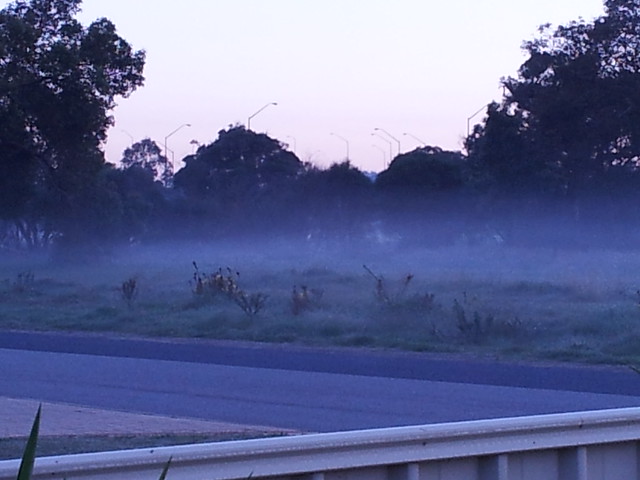 There are some compensations to getting up and leaving for work early. Unfortunately the one that means the most to me, I can't take a photo of as I am usually driving and for some reason people get quite upset if you try taking photos whilst driving!
There is a bit of wetland I pass on the way to the train station, and when the view from the front drive is like this, I know there will be a 'magical, mystical' view as I pass the wetlands. The trees are all interlaced with the mist, and the different greens and occasional autumnal/winter brown leaves make it look like somewhere else, possibly Europe, certainly a little closer to some one's dreamtime landscape
I think I should be spelling that 'myst', because at that time of day I am not really awake, though I am aware enough to keep both hands on the wheel (which is probably a good idea). As I drive past the wetland, stopping and starting with the traffic, I am mildly entertained in a slightly hypnogogic manner by wondering who lives by the 'mysterious lake' and what adventures they might likely face ... then I have to put the brakes on, because the lights have turned red and I have to get to the station in one piece for some totally mundane reason, and my idle musings are burnt away like the myst once the sun actually crawls out of her bed and hauls herself up over the horizon.
Monday, June 17
Polite Perth
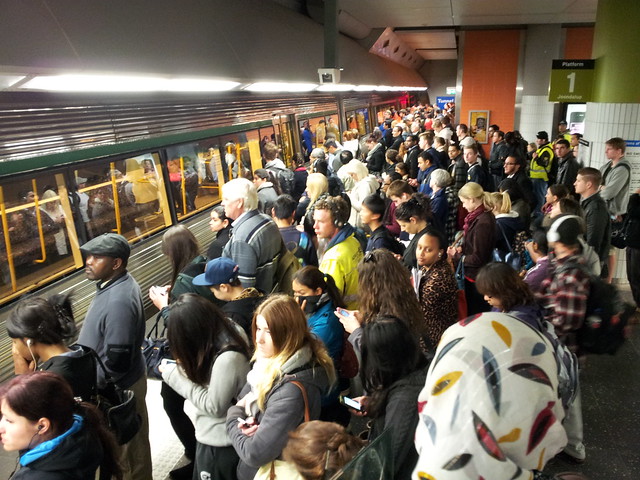
I was late to work this morning because a train got stuck in the underground tunnel. Apparently it got stuck quite early this morning, as I spoke to one chap at 8:30am who claimed he had been stuck long enough to get some coffee from the Hay St Mall. It smelt like good coffee too.
What struck me most was the reasonably cheerful resignation of the gradually increasing crowd on the platform. I did have one moment of distinct amusement though. Just as the damaged train crawled back into the station, an announcment was made that "The next train to Joondalup will depart in ... minutes."
What struck me most was the reasonably cheerful resignation of the gradually increasing crowd on the platform. I did have one moment of distinct amusement though. Just as the damaged train crawled back into the station, an announcment was made that "The next train to Joondalup will depart in ... minutes."
lt took another half hour before a train actually departed, and everyone piling into the carriages was accommadating and polite in moving into the carriage so everyone could get where they wanted to go.
I was quite impressed with my fellow train travellers this morning.
I was quite impressed with my fellow train travellers this morning.
Thursday, June 13
My man!
 My man has never worn glasses before, so this is the first time he has ever seen himself wearing them.
But it's not the first time he's made a spectacle of himself!
Also, this post was recorded on my phone which transcribed itself beautifully, all Star Trek like.
Well it would have done, if only my accent was 'pure' English/Australian/USian. That man of mine thought it amusing that I have to still edit for puntuation and capital letters, and repeat myself to get the words right, removing the excess like so much dead wood. It's a fun toy, and may actually be worth learning (if I can find the right help file) for recording the odd stray thought more quickly than diving into my handbag for a pen and notebook or scribbling a note on my phone with it's stylus.
Thursday, June 6
Everything needs a niche or two
I got stuck at the train station on Wednesday evening with a flat tyre. Waiting for the RAC to rescue me, I spotted this little chap and a mate running up and down the embankment. I think they are native rats (as they look a bit big for mice), as I know there are some in this area in spite of all the loose cats around.
Wednesday, June 5
Wednesday?
I'm never quite sure about Wednesdays. I think it is because it is neither one end of the week nor the other, and there is this mental lacuna as to what shape the day should be.
Monday has always been fairly straight forward. It is a STUFF TO DO! sort of a day, though with some regrets for the weekend just past.
Tuesdays feels more like that moment when you get in the zone and things just happen. I like days like that. Thursdays are often a zone kind of day too. And Fridays can be both days of completion or days of preperation for the weekend and the following week.
Tuesdays feels more like that moment when you get in the zone and things just happen. I like days like that. Thursdays are often a zone kind of day too. And Fridays can be both days of completion or days of preperation for the weekend and the following week.
But Wednesdays seem to have three modes. They either fit right in with Tuesdays and Thursdays, or are flatter than pancakes and much more boring, or they are exciting to one extreme or the other!

Finally my Star Trek dreams have come true!
Today is one of those as on my way home, I'm stuck at the train station with an incredibly flat tyre (I must have picked it up this morning on the way to the station *sighs*). Mind you, as I wait for the RAC to come and rescue me, I consider myself having achieved another of those 'bucket list" futuristic thingies that raised a low Wednesday to a high Wednesday *G*
The update to my phone's operating system means that I can just talk to my phone and my phone does the typing for me.
Finally my Star Trek dreams have come true!
Tuesday, June 4
Regular things ...
Recently, I read a post (though I can't find it right now) about 'the regular things' someone does each day. And it struck me that starting back at work and trying to maintain my previous 'regular things' would necessitate me getting up at five (or possibly four) in the morning - and that just is not happening for this little black duck!
Since I'm not too keen on the earlier wake up drill (definitely more of the owl than the lark) I decided to document what I did this morning, knowing that I had to be at the train station by 7:30 to catch the train.
I can get the day off to a reasonable start, providing I only skim the emails that have come in overnight and listen to the ABC Breakfast Show. But I am also starting to wonder that my internet fed mornings were probably getting a little out of hand as I am finding a real sense of missing something while staggering around the kitchen trying to wake up, eat breakfast, get dressed and read email. So this 'info-diet' could well remind me to practice a little more moderation in my info-consumption!
What I have noticed in this last week, is the regularity on my homeward journey of whipping through my twitter stream and favouring those sites that might provide an interesting longer read later in the evening. It is definitely one of the benefits of being chauffeured to work and back again. Doing it that way means I can read longer articles with more ease on my desktop or laptop screens. Shorter ones get read on the train inspite of the slower downloads.
Though I am starting to just favourite things far more for some reason. There seem to be a few more blogs and such that I'm reading... *g* Perhaps they will become part of my 'regular things' next month?
Since I'm not too keen on the earlier wake up drill (definitely more of the owl than the lark) I decided to document what I did this morning, knowing that I had to be at the train station by 7:30 to catch the train.
I can get the day off to a reasonable start, providing I only skim the emails that have come in overnight and listen to the ABC Breakfast Show. But I am also starting to wonder that my internet fed mornings were probably getting a little out of hand as I am finding a real sense of missing something while staggering around the kitchen trying to wake up, eat breakfast, get dressed and read email. So this 'info-diet' could well remind me to practice a little more moderation in my info-consumption!
What I have noticed in this last week, is the regularity on my homeward journey of whipping through my twitter stream and favouring those sites that might provide an interesting longer read later in the evening. It is definitely one of the benefits of being chauffeured to work and back again. Doing it that way means I can read longer articles with more ease on my desktop or laptop screens. Shorter ones get read on the train inspite of the slower downloads.
Though I am starting to just favourite things far more for some reason. There seem to be a few more blogs and such that I'm reading... *g* Perhaps they will become part of my 'regular things' next month?
Monday, June 3
Winter moon
It's not quite time for lunch and I get to see the moon above my gazebo where the bougainvillea is starting to really get going.

There is a gentle wind coming from the north west and standing downwind of my roses I am bathed in their sweet scent. Because now I have a job for five minutes they blossom like crazy, of course. It is a treat this morning to wander through my garden and see the difference a week makes in growth. Even the Mop-Top tree that hangs over the back fence is starting to look a little autumnally moth-eaten *G*
This means that this next month will have to see me repot my hanging garden and weed all the fast growing winter grass that just goes nuts at this time of the year. How odd. I'm actually looking forward to finishing that particular chore this year. And then I get to hack the roses back, in the anticipation of lots of roses next summer!
Sunday, June 2
Annoying changes (or where did I put my manual?)
On Friday I decided that I would take advantage of #BlogJune and add blogging apps to my smartphone (otherwise known as my spare brain).
So I upload the apps that I want to use, and they worked fine. Added words to apps on phone, check on the desktop at home (because of spelling and grammar and such - I would like to have some *G*).
I decide I want to illustrate my post yesterday morning, so wander over to Flickr to link to an image I had previously uploaded on to Flickr.com.
Disappointment strikes!
I cannot get my image to link between the two platforms!
Oh yes, Yahoo! has just updated the Flickr platform. And I spend an annoying hour searching for the instructions on how to just LINK to an image on my Flickr account.
Mind you, the irritation was not assisted by yesterday's delay in getting started because my smartphone decided to update itself and I then had to reorder the home screens so I can access the stuff I use the phone for. *grumps*
It is very disconcerting to suddenly have your brain (or spare brain) not work the way you have been used to it working. It is one thing to have change happen when it is expected and planned for, but another when your 'brain' changes unexpectedly in unexpected ways.
Anyway, I finally got everything to work and documented the process in my "Manual of Me" so I will remember it in the future.
So I upload the apps that I want to use, and they worked fine. Added words to apps on phone, check on the desktop at home (because of spelling and grammar and such - I would like to have some *G*).
I decide I want to illustrate my post yesterday morning, so wander over to Flickr to link to an image I had previously uploaded on to Flickr.com.
Disappointment strikes!
I cannot get my image to link between the two platforms!
Oh yes, Yahoo! has just updated the Flickr platform. And I spend an annoying hour searching for the instructions on how to just LINK to an image on my Flickr account.
Mind you, the irritation was not assisted by yesterday's delay in getting started because my smartphone decided to update itself and I then had to reorder the home screens so I can access the stuff I use the phone for. *grumps*
It is very disconcerting to suddenly have your brain (or spare brain) not work the way you have been used to it working. It is one thing to have change happen when it is expected and planned for, but another when your 'brain' changes unexpectedly in unexpected ways.
Anyway, I finally got everything to work and documented the process in my "Manual of Me" so I will remember it in the future.
Subscribe to:
Posts (Atom)